spring-ai-playground
title: Desktop App description: Install Spring AI Playground from the desktop installer - platform install notes, configuration walkthrough, MCP tools curation, and environment secrets.
Desktop App
The desktop installer is the recommended default. It wraps the Electron launcher, the JVM, and the Spring Boot fat JAR into a single platform installer (DMG / EXE / DEB / RPM) - no separate Java toolchain, no manual Docker setup. Compared with Docker or From Source, the desktop path adds a built-in configuration editor with provider starter templates, OS-encrypted secret storage for API keys, and an Ollama model manager.
For Docker or source / fat-JAR runs instead of the desktop installer, see Alternative Runtimes. For universal post-install steps (Your First Five Tasks, model configuration, telemetry), see Getting Started.
Download the Desktop Installer
Pick your installer from the Home page. Each badge resolves to the latest published release automatically and opens a confirm dialog with filename, size, and the typical OS save path. If you prefer the raw asset list, browse the Releases page directly.
The desktop package wraps the launcher and the backend runtime together, so this is the simplest way to get started without manually running Docker or Maven.
Want to confirm the file you downloaded is genuine? See Verify Your Download on the hub page.
Platform-specific install notes
macOS
If you install from a DMG, drag the app into Applications before launching it. Do not run it directly from the mounted DMG, and eject the DMG after copying.
Gatekeeper may block the install flow in two places:
1. Open the installer (DMG)
When you open the downloaded DMG, macOS may show a warning such as “cannot be opened because the developer cannot be verified.”
If you trust the release source:
- Try opening the DMG.
- If macOS blocks it, go to System Settings > Privacy & Security and click Open Anyway.
2. Launch the installed app
After copying Spring AI Playground.app into /Applications, macOS may block the first app launch again.
If that happens:
- Open the app once.
- Then go to System Settings > Privacy & Security and click Open Anyway.
If the app still doesn’t open because it remains quarantined, and you trust the app, one practical workaround is:
xattr -dr com.apple.quarantine "/Applications/Spring AI Playground.app"
Windows
The most common warning appears when you run the downloaded installer (.exe).
If Microsoft Defender SmartScreen shows a warning such as “Windows protected your PC” or says the app is unrecognized:
- Click More info
- Then click Run anyway
In most cases, the installer is the main warning point. Repeated blocking after installation is less common than on macOS.
Linux
Separate Gatekeeper- or SmartScreen-style reputation warnings are uncommon.
Install the package using the format that matches your distribution:
.debfor Debian or Ubuntu-based systems.rpmfor Fedora, RHEL, Rocky Linux, AlmaLinux, openSUSE, and similar RPM-based systems
You usually only need to complete the normal package-install confirmation steps, which may include an administrator password.
What the Desktop App Gives You
The desktop launcher includes a built-in configuration editor. In practical terms, that means:
- provider-specific starter settings for Ollama, OpenAI, and OpenAI-compatible servers
- YAML override editing instead of forcing you to edit the full bundled config
- environment-variable entry for API keys and tool secrets
- JVM options and application arguments for launch-time tuning
- import, export, save-as, delete, factory reset, and save-and-launch workflows
- automatic MLX model selection on Apple Silicon for faster local inference
- on-device speech-to-text model download for local voice input in Agentic Chat
After launch the app also stays resident in the tray or menu bar, so closing the window does not stop the server.
How the Desktop Config Works
The launcher does not expose the entire built-in config directly. Instead, the editor shows only the override YAML for the selected setting, and at launch that override is merged on top of the bundled default configuration.
That behavior is reflected in the desktop UI:
- selected config and setup notes
- provider type selector:
Ollama,OpenAI,OpenAI-Compatible - saved setting selection and
Save As - environment-variable management
- JVM settings
Save and Launch
This makes it much easier to keep multiple clean launch profiles without hand-managing full runtime configuration files.
Default MCP Tools Curation
Preset selection for the built-in MCP server happens inside the configuration editor, on the Default MCP Tools card (step 8 of the walkthrough below). The first launch opens Configure Spring AI Playground; pick a preset before clicking Save and Launch and that choice is written to <home>/spring-ai-playground/tool/save/default-tools-preference.json. Without an explicit pick the app falls back to Starter 5 - the cross-locale defaults that need no API keys.
Do not confuse this with the chat-side default: these presets decide which built-in tools are active on the MCP server, while a brand-new Agentic Chat opens with the Self-equipping agent prompt preset (chat.default-preset), which uses dynamic discovery to search whatever this card has activated.
The card writes default-tools-preference.json; the same preference can also be pinned via CLI / yaml. The app reads it at startup to decide which built-in tools are Local-Passed (active). Tool Studio’s Built-in MCP Server Native Tools drawer is a separate concern - it picks which Local-Passed tools the built-in MCP server exposes, not which are active.
The five presets:
Starter 5(default, no API keys) -getCurrentTime,getWeather,searchWikipedia,extractPageContent,evalExpression.Dev Essentials- local dev utilities (uuid,hash,base64,jwtDecode,regexExtract) plusgetCurrentTimeandevalExpression.Korea Toolkit (free)- free Korean services (Upbit, Bithumb, iTunes K-pop, K-beauty search) plusgetCurrentTimeandevalExpression.File Toolkit- filesystem pipeline (readTextFile,listDir,grepFile,findFiles,sliceFile,sortFile,cutFileFields) plusgetCurrentTimeandevalExpression. SetSPRING_AI_PLAYGROUND_TOOL_STUDIO_FS_BASE_PATHto pin a custom workspace root.Everything- exposes every default tool. Heavy MCP catalog.
The non-Starter presets each carry only getCurrentTime and evalExpression from Starter 5 by design - they do not stack on top of it.
Advanced curation stays folded by default in the editor - you click Show to open it. The details below mirror that folded section:
??? note “Show details”
Clicking **Advanced curation → Show** expands an Include / Exclude pair: add tools by tag, by category, or by name; remove tools by tag or by name. The chip pickers populate from the live catalog when the section opens (a brief flash of `Loading...` is normal - that's the IPC fetch).
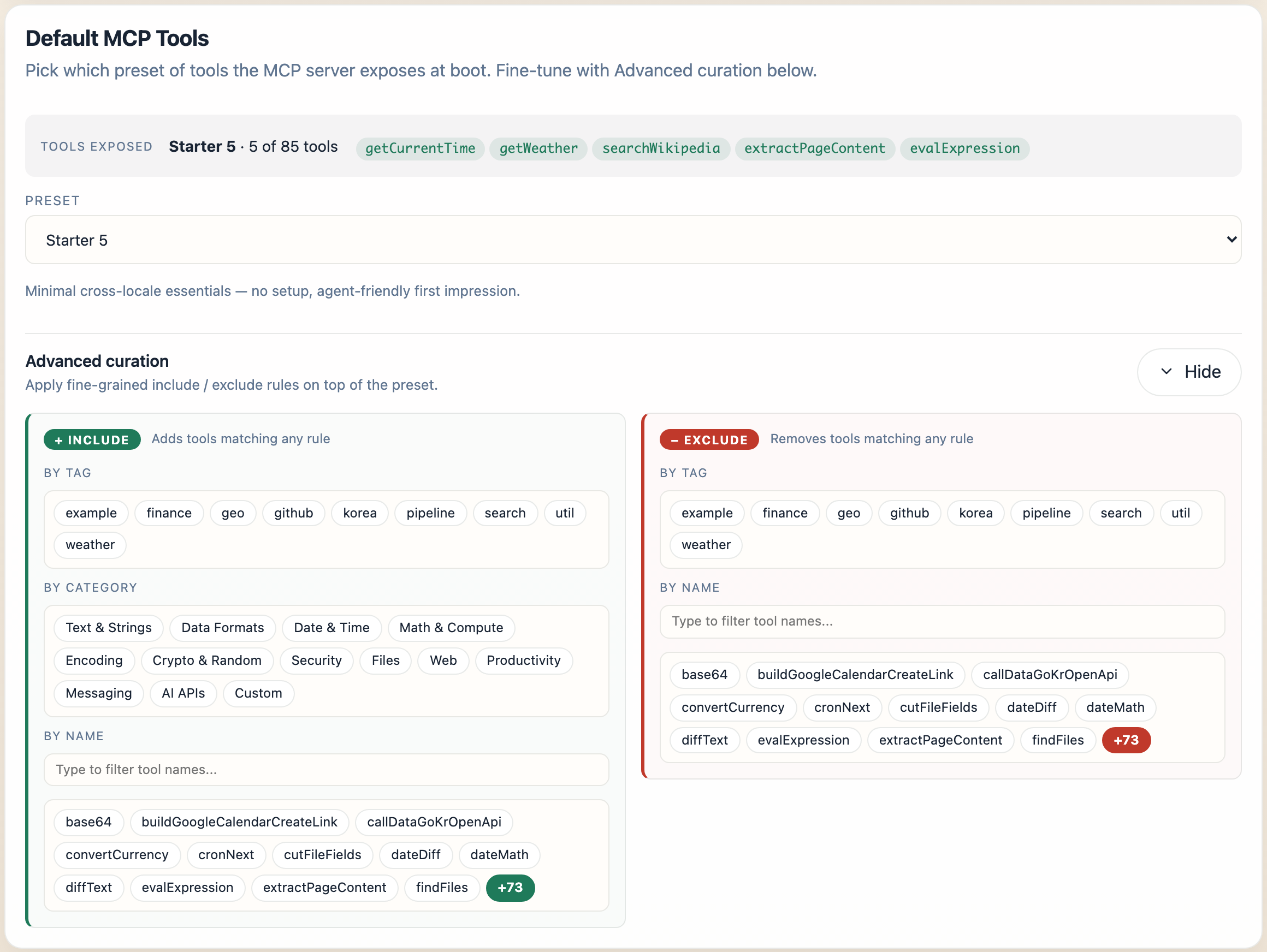
*The same card with `Advanced curation` expanded - Include (`+`) on the left adds tools matching any rule; Exclude (`-`) on the right removes them. Rules layer in this order: name-add → tag-add → category-add → name-remove → tag-remove → category-remove.*
For the full preset contents, the CLI override, and the migration note from the prior defaultToolOverrides.json, see Tool Studio → Pre-built Example Tools.
Desktop Configuration Walkthrough
The launcher’s Configure Spring AI Playground screen opens on the very first launch and any later launch where you re-enter configuration mode. Once you have saved a configuration and chosen a preset, subsequent launches reuse them automatically and skip straight to the app.
1. Read the Setup Notes First
The first card is Current Config and Setup Notes. It explains the active setting before you edit the YAML below.
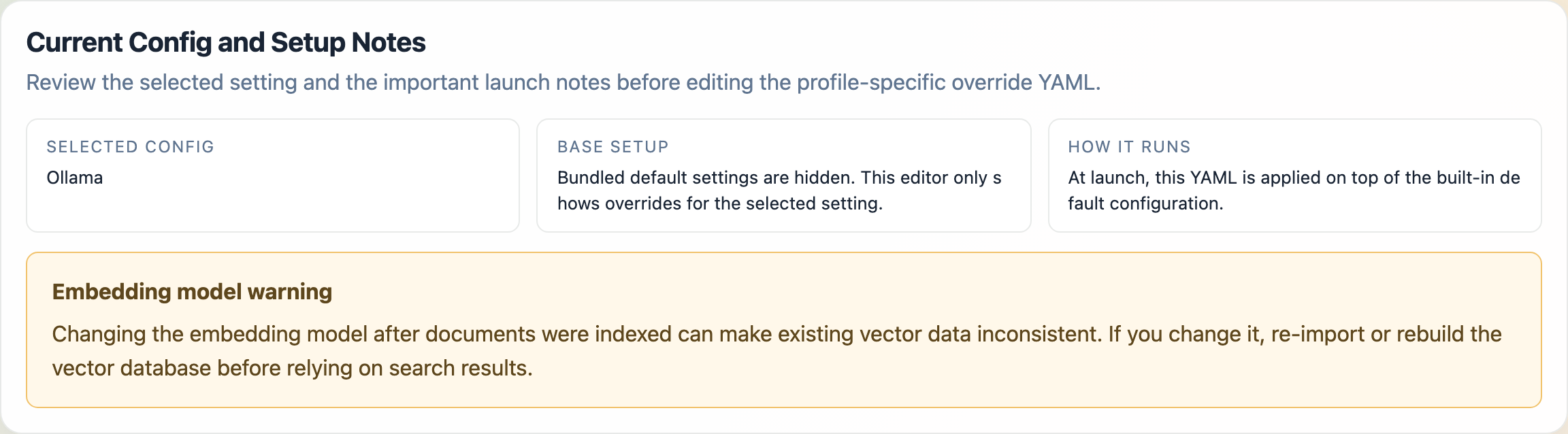
Selected Config: the active saved setting nameBase Setup: the launcher hides bundled defaults and only lets you edit overridesHow It Runs: the selected YAML is applied on top of the built-in default configuration at launch
If the selected setting includes an embedding model, the launcher also shows an Embedding model warning. That warning matters because changing the embedding model after documents were already indexed can leave existing vector data inconsistent until you re-import or rebuild the vector database.
2. Choose a Config Type
The main editor card is Spring AI Playground Config.
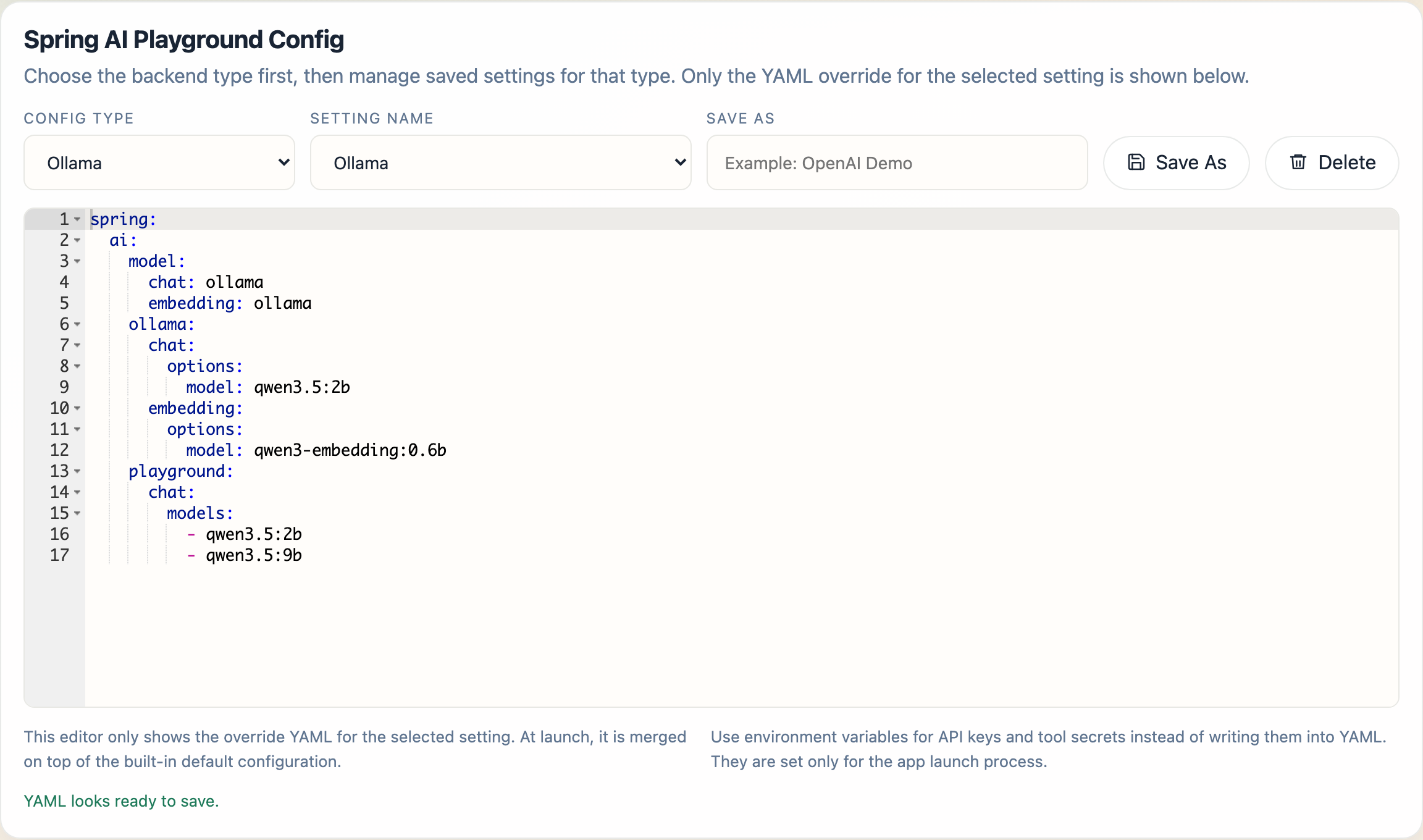
Within that card, Config Type chooses the backend family for the current setting:
OllamaOpenAIOpenAI-Compatible
This selector changes the kind of starter setting you are working with. It does not expose the full bundled configuration. It switches the saved-setting list and the override YAML editor to the selected backend family.
3. Choose a Saved Setting
Setting Name selects a saved launcher profile for the chosen config type.
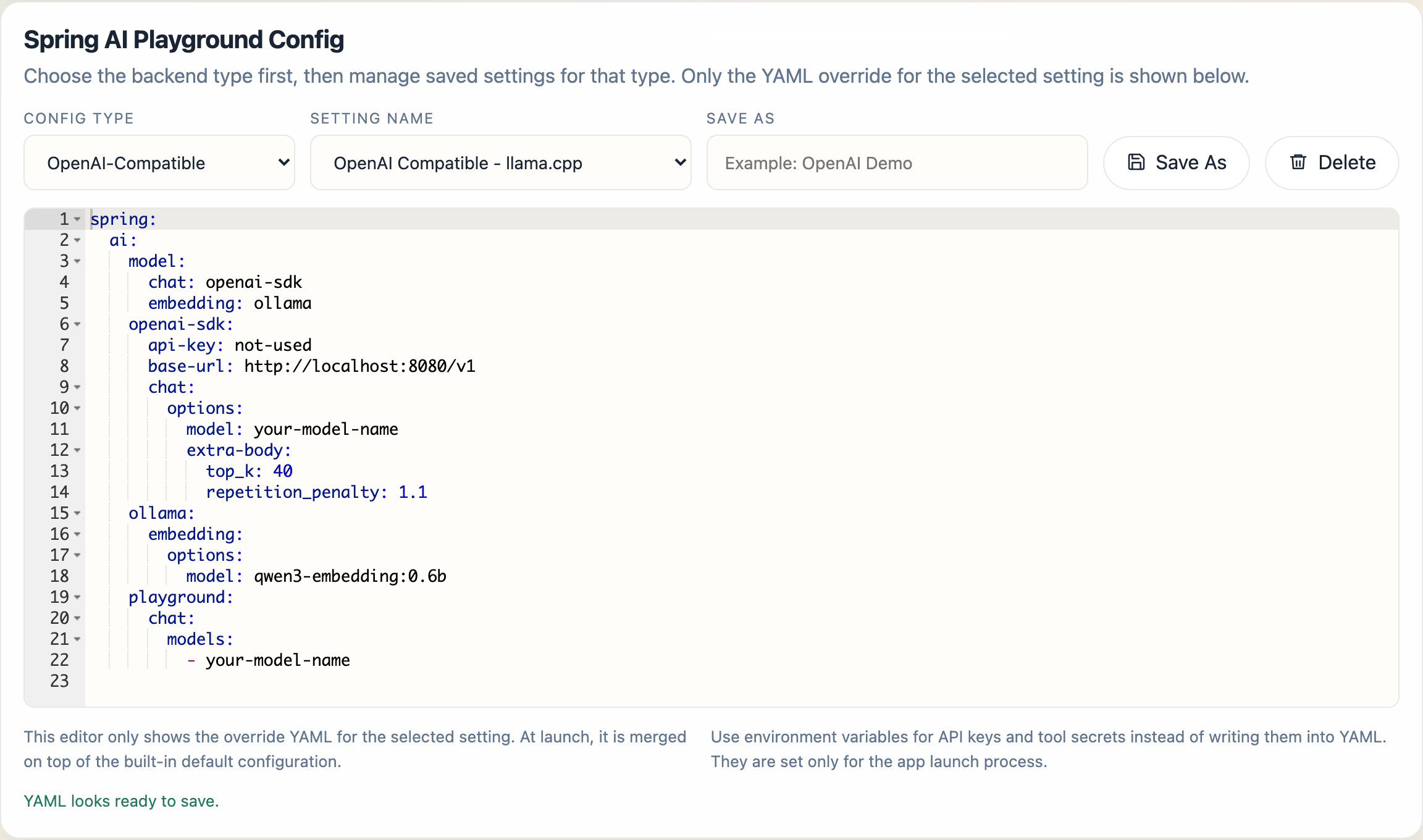
In the current desktop build:
Ollamastarts with the built-inOllamasettingOpenAIstarts with the built-inOpenAIsettingOpenAI-Compatiblestarts with built-in compatible profiles such asOpenAI Compatible - Ollama,OpenAI Compatible - llama.cpp,OpenAI Compatible - TabbyAPI,OpenAI Compatible - LM Studio, andOpenAI Compatible - vLLM
OpenAI-Compatible is intended for servers that expose an OpenAI-style API but are not the official OpenAI endpoint. For the base URL and YAML each compatible runtime expects (LM Studio, vLLM, llama.cpp, TabbyAPI), see External Connections → OpenAI-compatible servers.
4. Save, Clone, Delete, or Reset Settings
You manage settings without ever editing the bundled base configuration. Two buttons sit on the Spring AI Playground Config card itself (next to the Save As field, shown in the screenshot in step 2):
Save As- creates a new saved setting from the current YAML and launcher state; type a name in the field firstDelete- removes the currently selected saved setting
Every other action lives in the action bar pinned to the bottom of the screen, which stays visible no matter which cards are expanded. The numbered markers on the screenshot match the list below:

- Export - writes the current setting to a portable config file you can share or back up
- Import - loads a previously exported config file
- Factory Reset - deletes all saved configs, profiles, and stored API keys, then restarts the launcher
- Save - stores the current launcher state without starting the app
- Save and Launch - saves first, then boots Spring AI Playground; this is the button you use for a normal launch
Config export intentionally leaves out local environment-variable values for safety.
5. Edit Only the Override YAML
The YAML editor is intentionally scoped to override content, not the full base file. At launch, the selected YAML is merged on top of the bundled default configuration.
That design keeps the common configuration flow simpler:
- keep a stable bundled default
- store only what differs for this setting
- switch between clean launch profiles quickly
For every property the bundled configuration supports and its default value, see the Configuration reference.
6. Understand the Ollama Startup Card
When Config Type is set to Ollama, the launcher shows an additional Ollama Startup section.
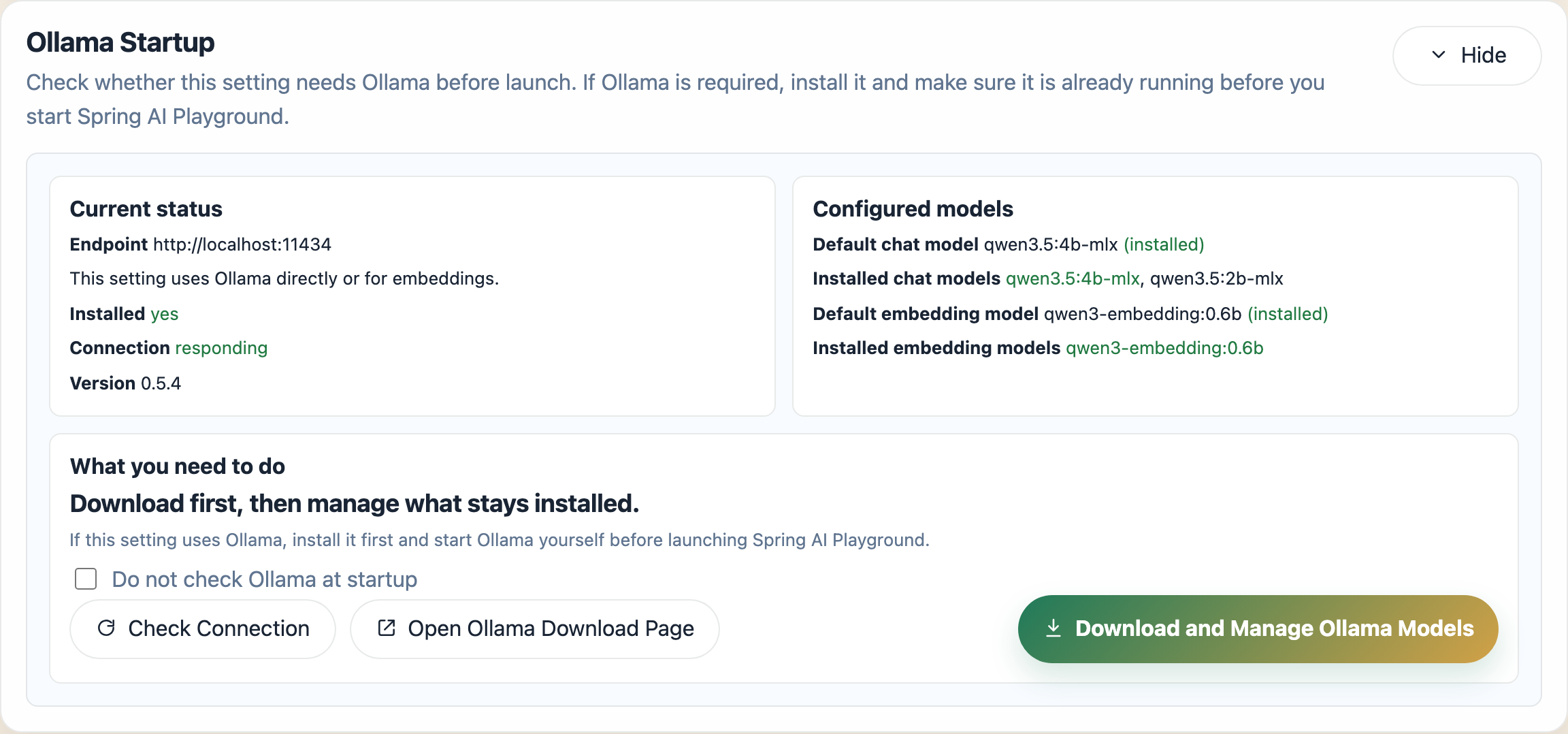
That section shows:
- the Ollama endpoint, install status, connection status, and detected version
- the configured default chat model and default embedding model
- installed chat and embedding models, with the currently configured defaults highlighted
- whether a configured model appears to be installed, not installed, or unknown because Ollama is unreachable
The action area also includes:
Check ConnectionOpen Ollama Download PageDownload and Manage Ollama Models: opens the separate Download and Manage Ollama Models guide belowDo not check Ollama at startup
This section is currently shown for the Ollama config type. Even if an OpenAI-Compatible profile still uses Ollama for embeddings, the dedicated Ollama startup card is not shown automatically in this first-page flow.
On Apple Silicon the model names shown here are the MLX-optimized builds (for example qwen3.5:4b-mlx); see Apple Silicon and MLX models for why.
7. Download and Manage Ollama Models
The Download and Manage Ollama Models button on the Ollama Startup card above opens a separate model-manager window. This is where you pull the chat and embedding models your setting needs before you launch. The window starts with profile context at the top: the selected config name, Ollama install status, endpoint, and current connection state.

Finding and downloading a model by name
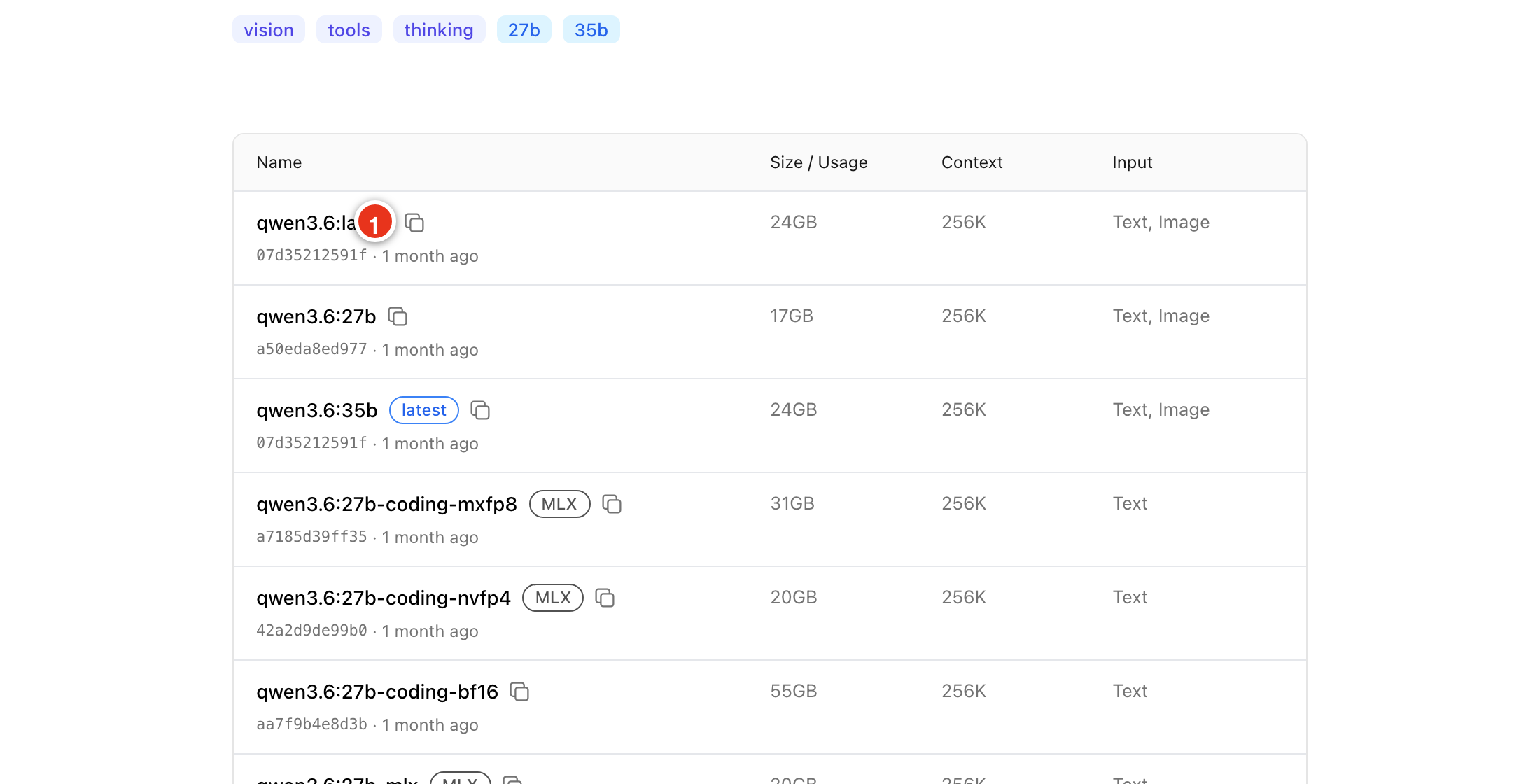
The Download by model name field takes an exact Ollama model identifier (model or model:tag) and queues a download. The reliable way to get that identifier right is to copy it straight from the model’s tag list on ollama.com.
Find on Ollama opens the Ollama model search in your browser, pre-filled with whatever you typed. Open the model you want - for example qwen3.6 - then open its Tags list. Every variant is listed there, and hovering a row reveals a copy button at the end of it. For an Apple-Silicon build, hover the -mlx tag you want (for example qwen3.6:27b-mlx) and click its copy button (marker 1):
Then it is just copy and paste:
- in the tags list, hover the model variant you want and click its copy button (marker 1)
- switch back to the manager and paste into
Download by model name- keep only the model identifier (for exampleqwen3.6:27b-mlx) - click the download button - labelled
Queue download- to add it to the queue
Queuing only pulls the model into Ollama; it does not change the current YAML profile by itself. To make a downloaded model the default, set it in the config YAML (step 2 of the walkthrough).
Recommended and Downloaded tabs
The default Recommended tab lists the embedding model configured for the current profile first, then the chat models from the active YAML profile:
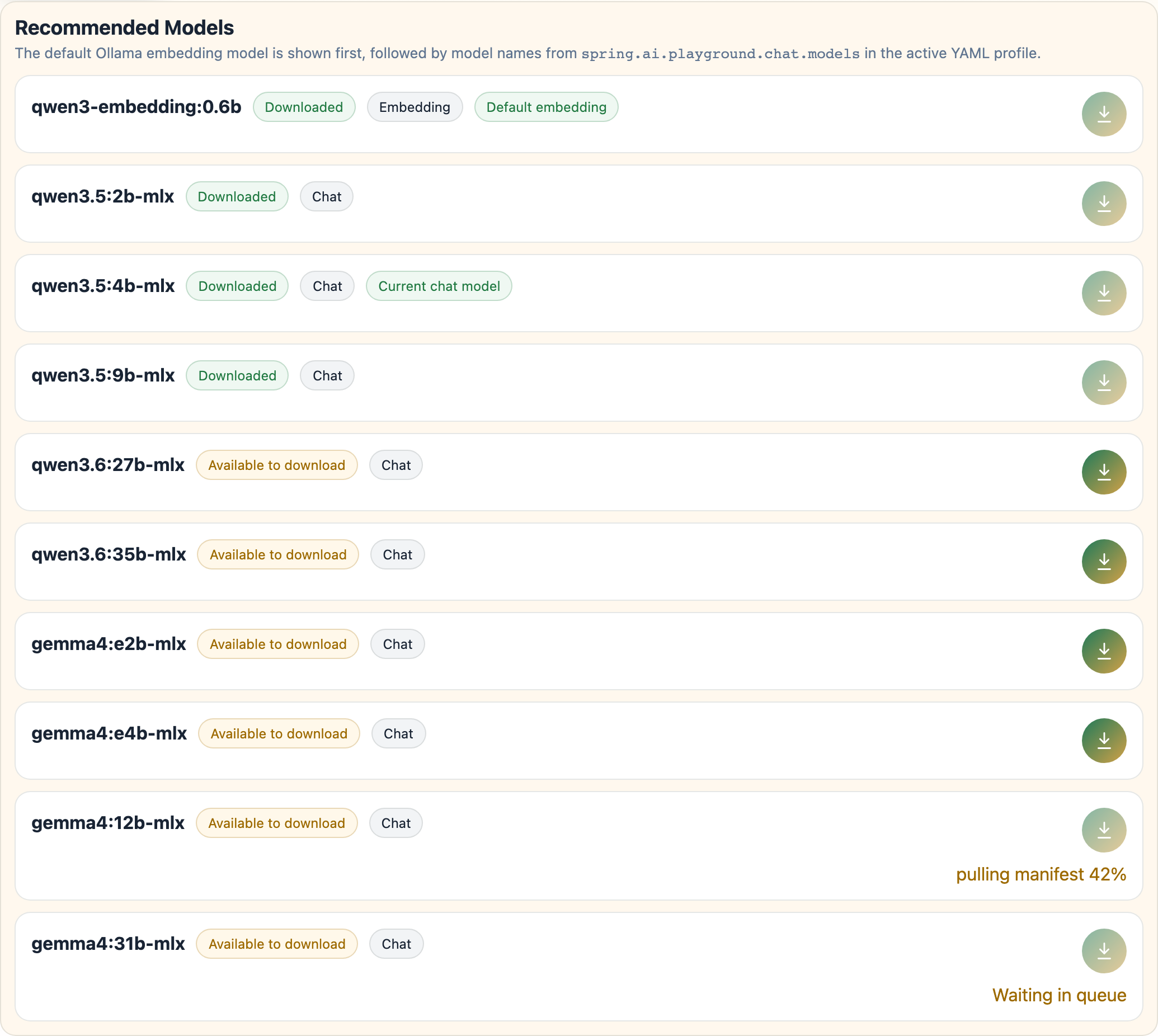
Each row shows whether the model is already downloaded, badges such as Embedding, Chat, Default embedding, and Current chat model, and a per-model download button that queues that model when it is not yet available locally.
The Downloaded tab focuses on models that already exist in the local Ollama store, grouped by type:
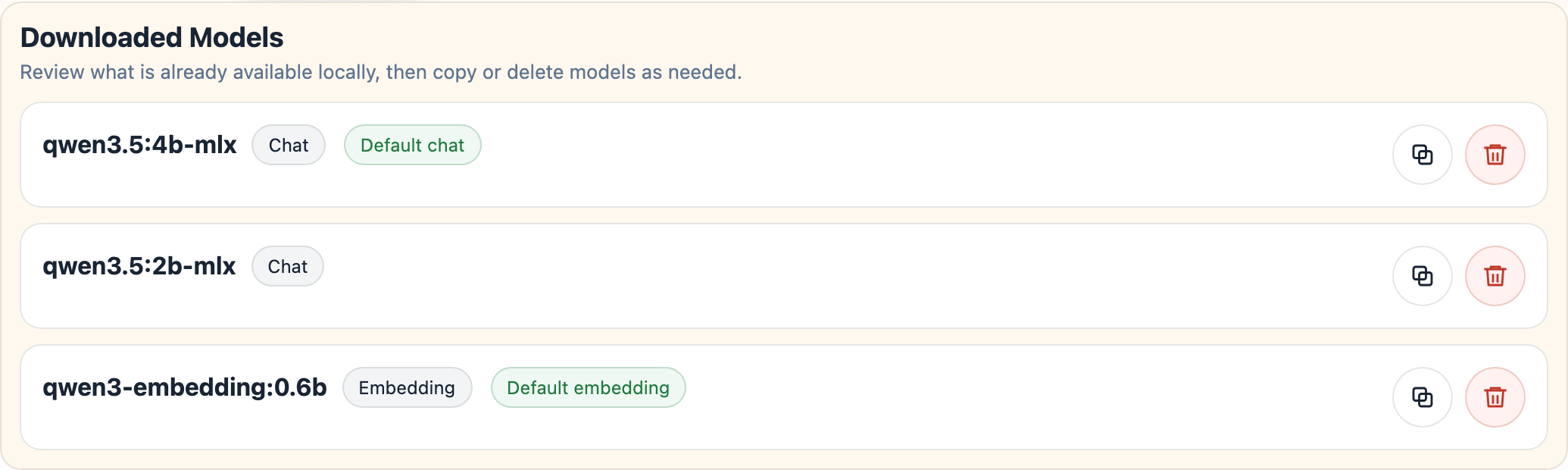
Copy model as...duplicates a model under a new Ollama nameDelete modelremoves the selected model from the local Ollama store
The download queue
Anything you queue - from Download by model name, the Recommended tab, or a per-model download button - lands in the Download Tasks panel at the top of the manager. Downloads run one at a time.
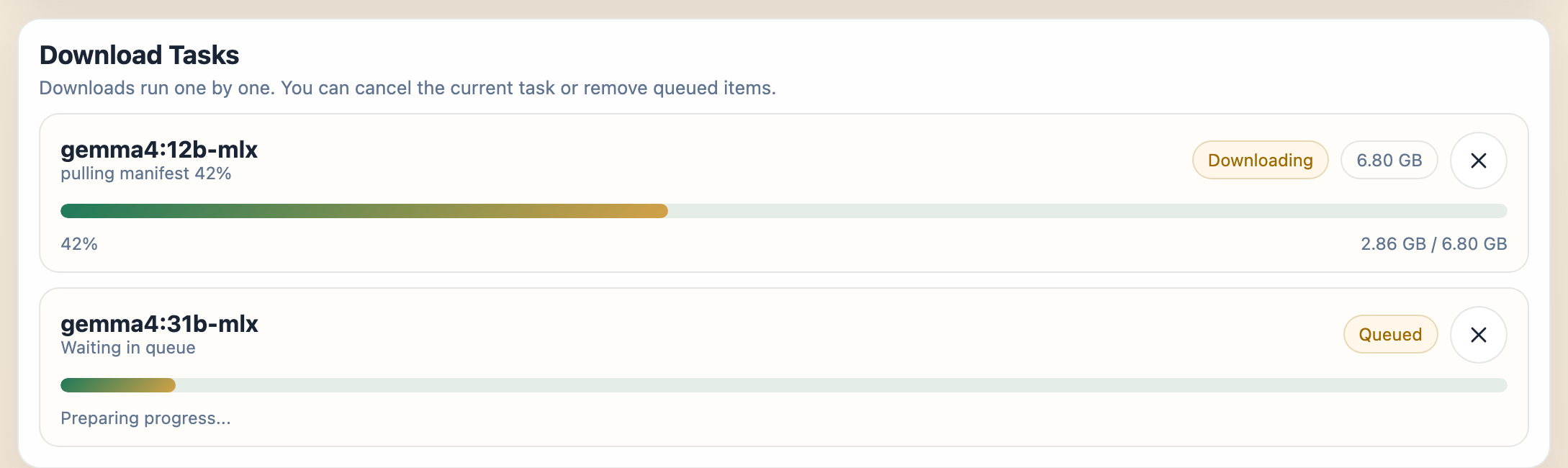
Each task shows a live progress bar, the downloaded / total size, and a status badge (Queued, Preparing, Downloading, Completed, Canceled, or Failed). While a task is still Queued, Preparing, or Downloading, the Cancel (x) button stops it; a Failed task shows a Retry button instead. Canceling the running download lets the next queued model start.
8. Pick Your Default MCP Tools
The next card down the screen is Default MCP Tools. It chooses which preset of built-in tools the MCP server exposes the moment it boots.
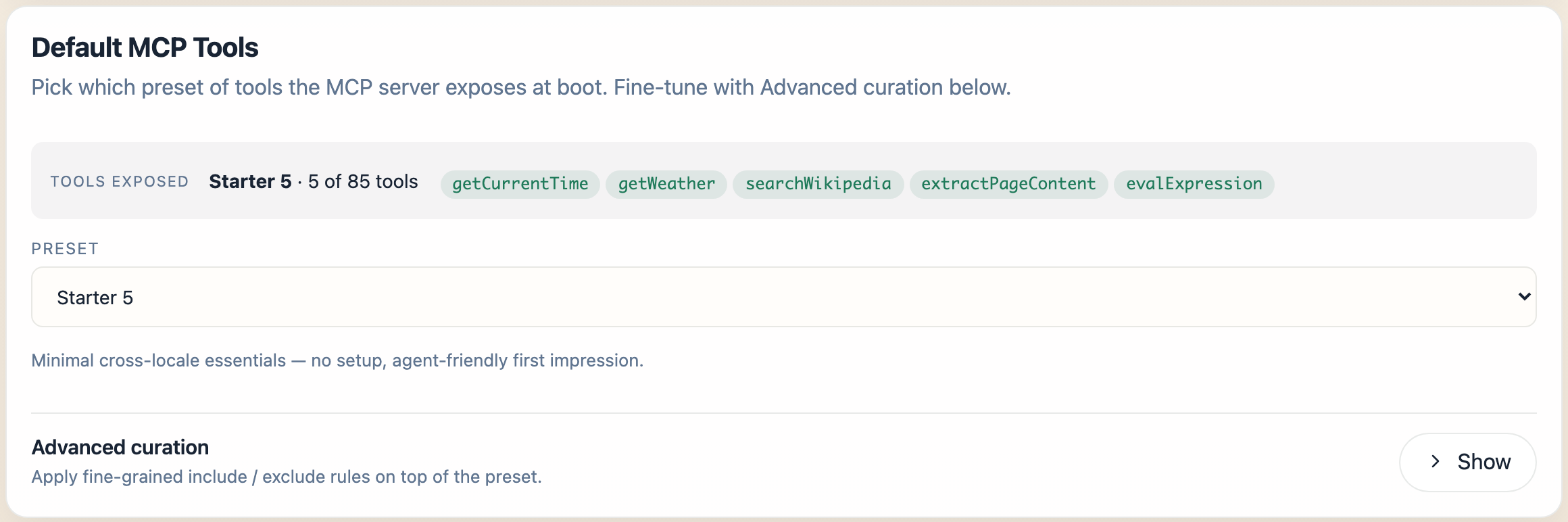
Pick a preset - the default Starter 5 needs no API keys. The full per-preset tool lists, the include / exclude Advanced curation rules, and the CLI / YAML equivalents are all covered in Default MCP Tools Curation above; the tools themselves live in Tool Studio.
9. Use Environment Variables for Keys and Secrets
When the selected setting or bundled tools need secrets, the launcher shows an Environment Variables section. This is where you keep API keys and tool secrets out of YAML. For the full list of configuration knobs (beyond secrets) and how each maps to a property or env var, see the Configuration reference.
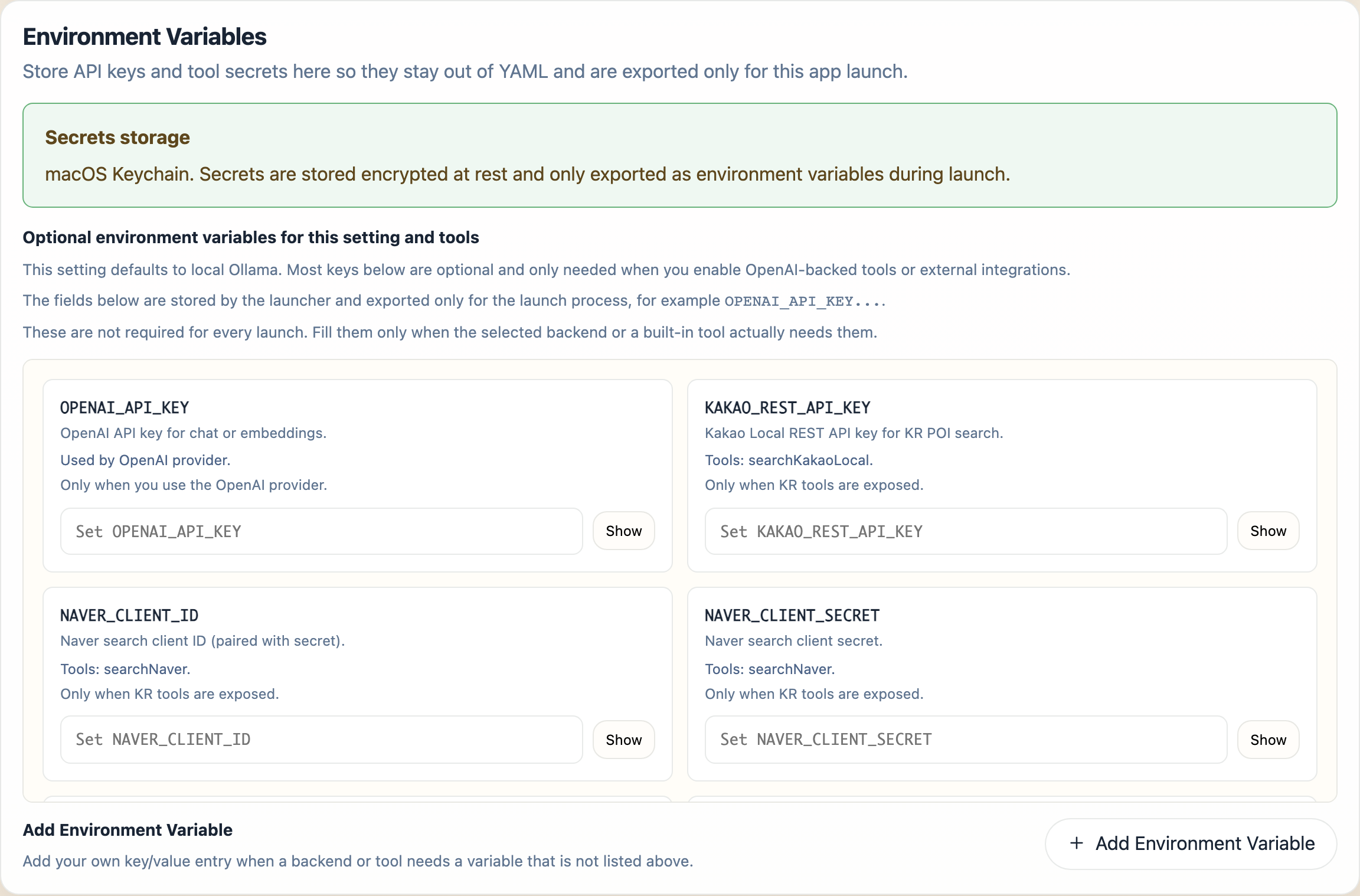
Typical entries include:
OPENAI_API_KEYGOOGLE_API_KEYGOOGLE_PSE_IDSLACK_WEBHOOK_URL- custom variables added with
Add Environment Variable
The launcher behavior is important here:
- values are stored per saved setting
- values are exported only for the app launch process
- values are not meant to be written into the YAML override
- the UI can list both backend-required keys and optional tool-related keys
The card also shows the current secret-storage mode:
- Encrypted by your OS secure storage - Electron’s
safeStorageAPI is using the platform secure store under the hood: macOS Keychain, Windows DPAPI (current-user scope), or libsecret / GNOME Keyring / KWallet on Linux. The launcher writes the ciphertext to<userData>/spring-ai-playground/config/secrets.storeon disk; the decryption key never leaves the OS keychain. - OS-backed encryption unavailable - stored as plain text in this session - fallback when no platform secure store is reachable (typical on bare Linux without a keyring daemon, or in some sandboxed Linux containers). The same file is written in plain JSON so values still survive the launch, but they are no longer encrypted at rest.
The launcher’s secret workflow is the same in both modes:
- values are stored per saved setting (
configIdkeyed) - values are exported only as environment variables to the launched Spring AI Playground JVM - they never get written into the YAML override or into chat history
- the secrets file is rewritten on every save; a legacy
secrets.json.encfrom older versions is auto-renamed tosecrets.storeon first read - on macOS and Linux the secrets file is written with owner-only permissions (
chmod 600) so other accounts on the machine cannot read it
This is why the env-var pathway is the recommended place for OPENAI_API_KEY, SLACK_WEBHOOK_URL, GOOGLE_API_KEY, and any other tool-side secret - the value reaches Tool Studio and the bundled tools through System.getenv() rather than through a config file checked into git.
The resolved value is also masked from console.log output in Tool Studio’s Debug Console and in Agentic Chat’s tool-call trace - any tool that references the env var as a static variable (or builds a string containing its resolved value) sees the secret substring replaced before the line surfaces in the UI. See Tool Studio → Built-in JavaScript Helpers - console.log for the masking rule details (anchored full-string env-refs are auto-collected; substring-concatenated values are masked best-effort).
For the current desktop behavior:
OpenAIrequiresOPENAI_API_KEYbefore launchOpenAI-Compatiblecan show an API key field, but it is only needed when that compatible server expects oneOllamausually does not require an API key for the backend itself, but optional tool integrations may still use environment variables
10. Set JVM and App Args Only When Needed
The JVM Settings card stays folded by default in the editor - you click Show to open it - because most launches do not need it. The details below mirror that folded card:
??? note “Show details”
The desktop editor includes a **JVM Settings** section for launch-time runtime options.
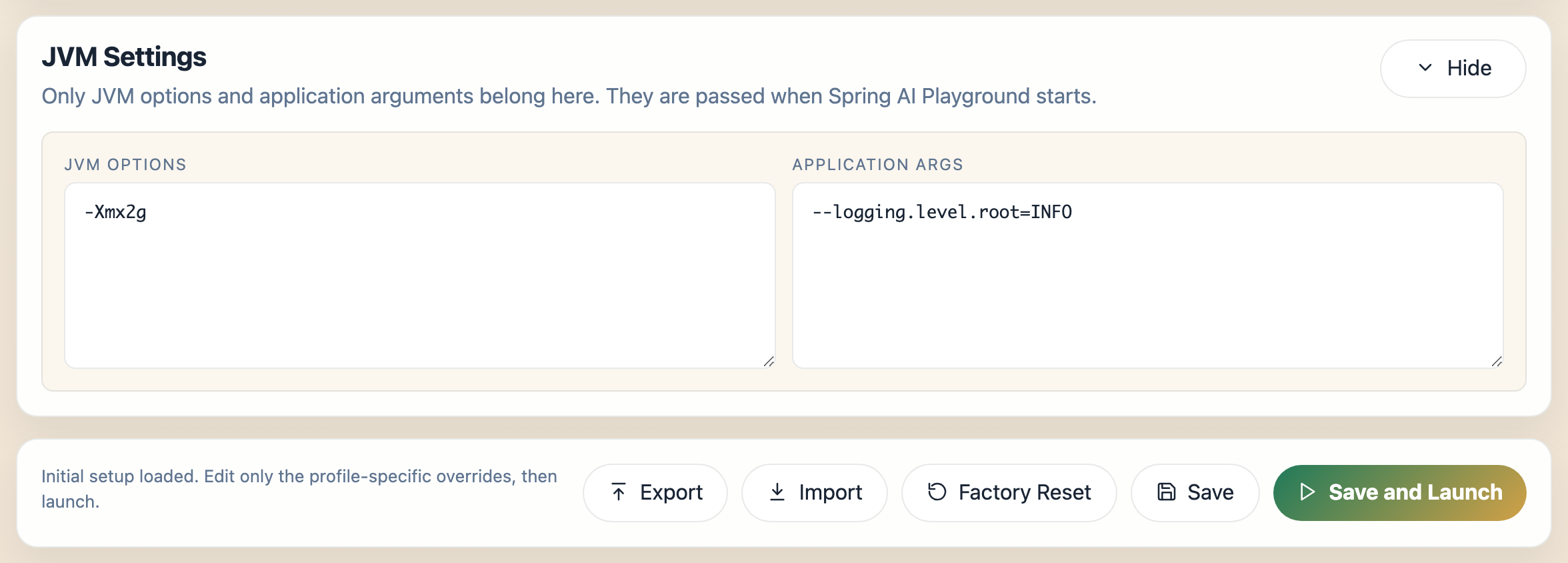
The expanded section has two fields:
- **JVM Options** - flags passed to the Java process, such as `-Xmx2g` to raise the heap limit
- **Application Args** - Spring Boot arguments appended to the launch, such as `--logging.level.root=INFO`
These are launch-time settings, not provider secrets. The action row beneath every card - `Export`, `Import`, `Factory Reset`, `Save`, and `Save and Launch` - stays visible regardless of which sections are expanded.
11. Recommended First-Launch Flow
For a clean first launch:
- choose
Ollama,OpenAI, orOpenAI-Compatible - review the generated YAML override instead of trying to recreate the full application config
- fill only the environment variables required by that backend or by the tools you actually plan to use
- for
Ollama, make sure Ollama is installed, running, and has the models you selected - click
Save and Launch
12. What You See After Save and Launch
After you click Save and Launch, the launcher opens a separate startup window while Spring AI Playground boots in the background.
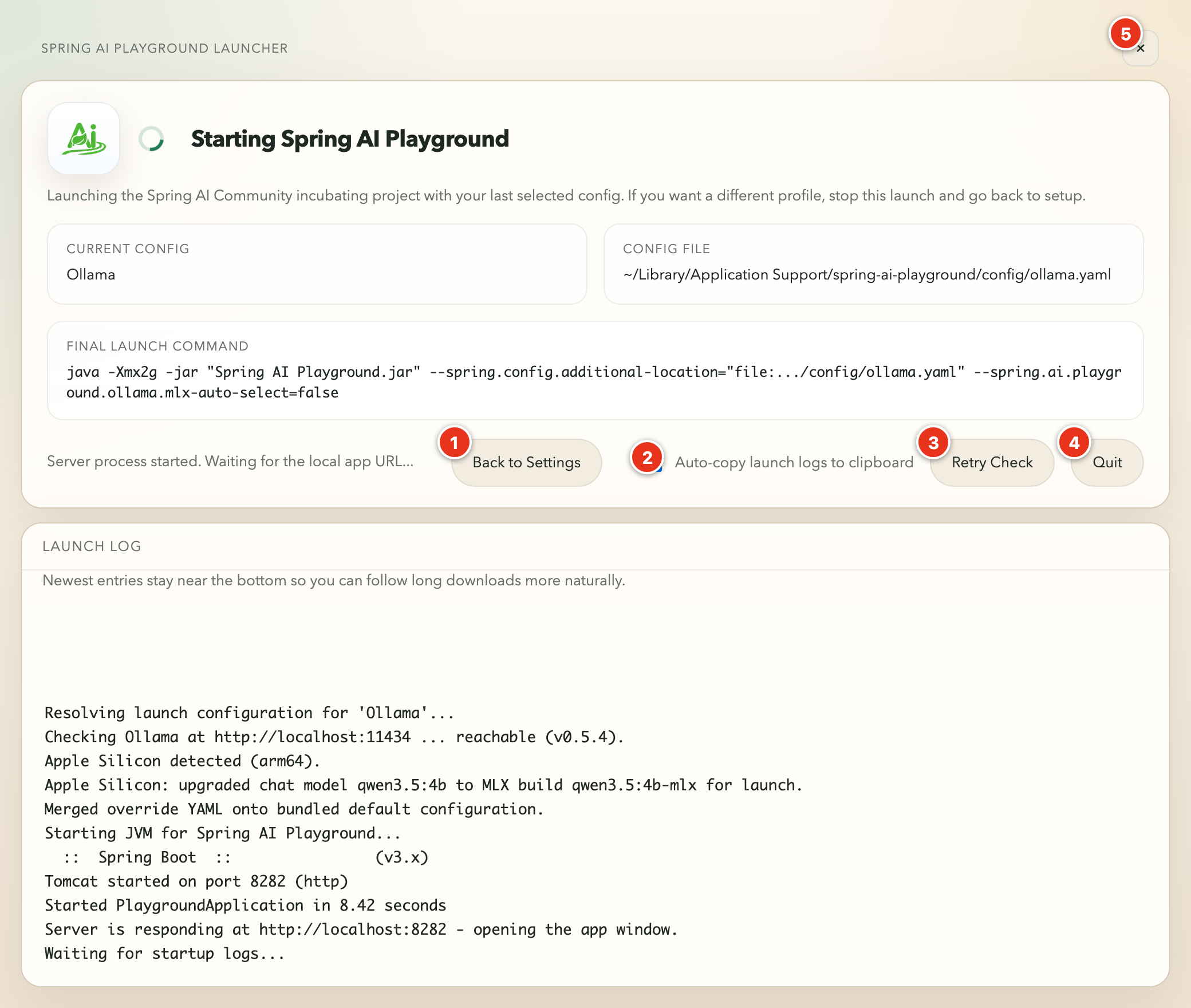
That startup window has four read-only fields:
Current Config- the saved setting being launchedConfig File- the resolved YAML file path used for this launchFinal Launch Command- the full Java command the launcher built for Spring AI PlaygroundLaunch Log- live startup output: Ollama checks, config resolution, server readiness messages, and (on Apple Silicon) the MLX upgrade line
The numbered markers on the screenshot point to the controls along the action row:
- Back to Settings - stops the current launch and returns to the configuration screen
- Auto-copy launch logs to clipboard (checkbox) - when ticked, each new log line is copied to the clipboard as it streams, so you can paste a complete startup log into a bug report without scrolling back
- Retry Check - reruns the readiness checks if startup is taking longer than expected
- Quit - stops the launch and closes the launcher
- close (x) - the control in the top-right corner; does the same as
Quit
If startup takes longer than expected, the launcher stays open and keeps streaming logs instead of failing immediately. This is especially helpful when local models are still warming up or downloads are still completing.
Tray and Menubar { #tray }
The desktop app also lives in the system tray: the menu bar on macOS, the notification area on Windows, the tray or indicator area on Linux. The icon appears as soon as the app starts, before you even reach Save and Launch, and it stays there until you quit.
The menu is the app’s out-of-window control panel. Top to bottom it holds the running version, Open Spring AI Playground, Recent Activity, a Settings submenu that jumps straight to a card in the configuration editor (config type and saved settings, the YAML editor, Default MCP Tools, Environment Variables, JVM and App Args), the Ollama model manager and the voice model manager, an Updates submenu, Open App Home Folder, a System submenu, and Quit.
Closing the window does not quit the app { #close-to-tray }
While the Spring server is running, the main window’s close button hides the window instead of closing it. The server, your conversations, and any in-flight work keep running in the background. If the window is full screen it leaves full screen first and then hides.
The first time this happens you get a one-time desktop notification titled Still running in the tray, so the app never disappears silently. Clicking that notification brings the window straight back. The notice is shown once and never again; after that the window just hides.
This only applies while there is a running server to come back to. If the server is already stopped, or the app is quitting, or you asked to return to the configuration screen, the close button closes the window normally.
Bringing the window back { #reopen }
Any of these reopens the app:
- click the tray icon and choose
Open Spring AI Playground(on Windows and Linux a single click pops the menu open) - click the one-time Still running in the tray notification
- start the app again - a second launch does not start a second copy, it raises the window you already have
- on macOS, click the app icon in the Dock
If the window itself is gone while the server is still running, reopening recreates it and loads your most recent page instead of Home. If the server stopped while the window was hidden, the launcher releases that hidden window, and reopening from the tray takes you back to the configuration screen instead.
Quitting for real { #quit }
Quit at the bottom of the tray menu is the way out. It stops the Spring server, waits for the shutdown to complete, and only then exits, so the port and the model memory are released cleanly. The platform quit action (for example Cmd+Q on macOS) runs the same shutdown path. Closing the window alone does not stop the JVM.
Recent Activity { #recent-activity }
Recent Activity lists the pages you last had open in the app - up to seven of them in the menu, most recent first - and clicking one reopens the app directly on that page instead of on Home.
- entries are recorded from main-window navigation, including in-page route changes, and are labelled with the page title when there is one and with the route name otherwise (
Agentic Chat,MCP Server,Vector Database,Tool Studio,Observability,Home) - an Agentic Chat entry keeps its
?conv=query, so it reopens on that conversation - OAuth completion pages are skipped, and only pages served by the running app are recorded
- the list is stored in
<userData>/configs/recent-activity.jsonand survives restarts; it keeps the last 20 entries - entries are greyed out while no server is running, and
Clear Recent Activityempties the list
Updates and Launch at startup { #updates }
The Updates submenu owns update checking for the whole app (the in-app home view deliberately leaves it to the tray). One check runs quietly at startup, and Check for Updates runs it on demand and reports the outcome in a dialog.
When a newer release exists, the tray icon switches to its update variant, its tooltip gains an update <version> available suffix, and a download entry appears in the submenu:
- on packaged Windows and Linux builds,
Download and Install ...fetches the update in the background (the tray tooltip shows the percentage) and then offers Restart and Install or Install on Quit; if that background download fails it falls back to opening the download page in your browser - on macOS, the entry is
Download ...and it opens the release asset in your browser, because an unsigned build cannot be swapped in place; you then install it the same way you installed the app in the first place
The submenu also links back to this page: Install Help (this OS) opens the install notes for the platform you are on (macOS, Windows, Linux), and Documentation opens the documentation home.
The System submenu holds three machine-level switches:
- Launch at startup - a checkbox that registers or unregisters the app as an OS login item, so it comes back with the tray icon after a reboot
- Start Ollama with app - on by default; the launcher starts a local Ollama for you when it is not already running, and tells you so with a notification
- Factory Reset - the same destructive reset as the action bar button, behind a confirmation dialog: it deletes every saved setting, secret, and workspace file, then restarts the app
Apple Silicon and MLX models
On Apple Silicon Macs, the launcher automatically prefers Apple’s MLX-optimized Ollama model builds, which run significantly faster than the generic builds on M-series hardware. You do not need to enable anything - the launcher handles it whenever the config type is Ollama and it detects an arm64 machine.
- MLX starter defaults. The Ollama starter setting ships
-mlxmodel variants: the default chat model isqwen3.5:4b-mlx, and thespring.ai.playground.chat.modelslist is the-mlxbuild of each suggested model (qwen3.5:2b-mlx,qwen3.5:9b-mlx,gemma4:e4b-mlx, and so on). The Ollama Startup card and the Ollama model manager then surface those-mlxbuilds. -
Launch-time upgrade. When you click
Save and Launch, the launcher looks at the configured chat model. If a matching-mlxbuild is already installed in Ollama, it transparently upgrades the launch to that build and records it in the Launch Log:Apple Silicon: upgraded chat model qwen3.5:4b to MLX build qwen3.5:4b-mlx for launch.Only plain
-mlxbuilds are auto-selected;-mlx-bf16variants are left untouched. If the-mlxbuild is not installed locally, the configured model launches unchanged.
Because the launcher owns this decision, it passes --spring.ai.playground.ollama.mlx-auto-select=false to the JVM so the backend does not resolve the model a second time. On Intel Macs, Windows, and Linux the configured model name is used as-is.
To install the -mlx builds, open Download and Manage Ollama Models; the Recommended tab lists the -mlx models for the active profile.
Local Speech-to-Text (Whisper)
The desktop app can transcribe voice input for Agentic Chat on-device - it runs a local Whisper model on your machine, set up here in the config editor, so audio never leaves your machine. This is a desktop-only capability; in a browser the chat mic falls back to the cloud-backed Web Speech API instead.
Speech-to-text is off by default, and the model is not bundled with the app - you opt in and download a model once from the config editor’s Local Speech-to-Text card:
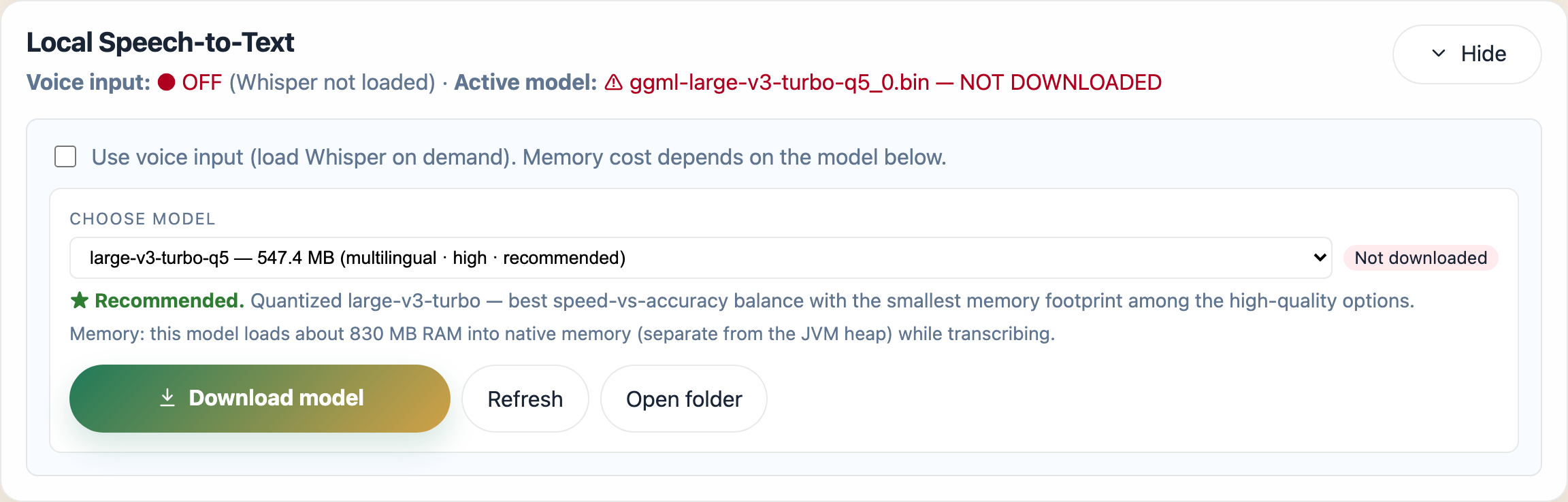
- Open the Local Speech-to-Text card in the config editor. Its header line summarizes the current state - whether voice input is on and which model is active.
- Tick Use voice input to load Whisper on demand.
-
Click Download and Manage Voice Models. Model management opens in its own window, with status cards for voice input, the active model, and the model folder:
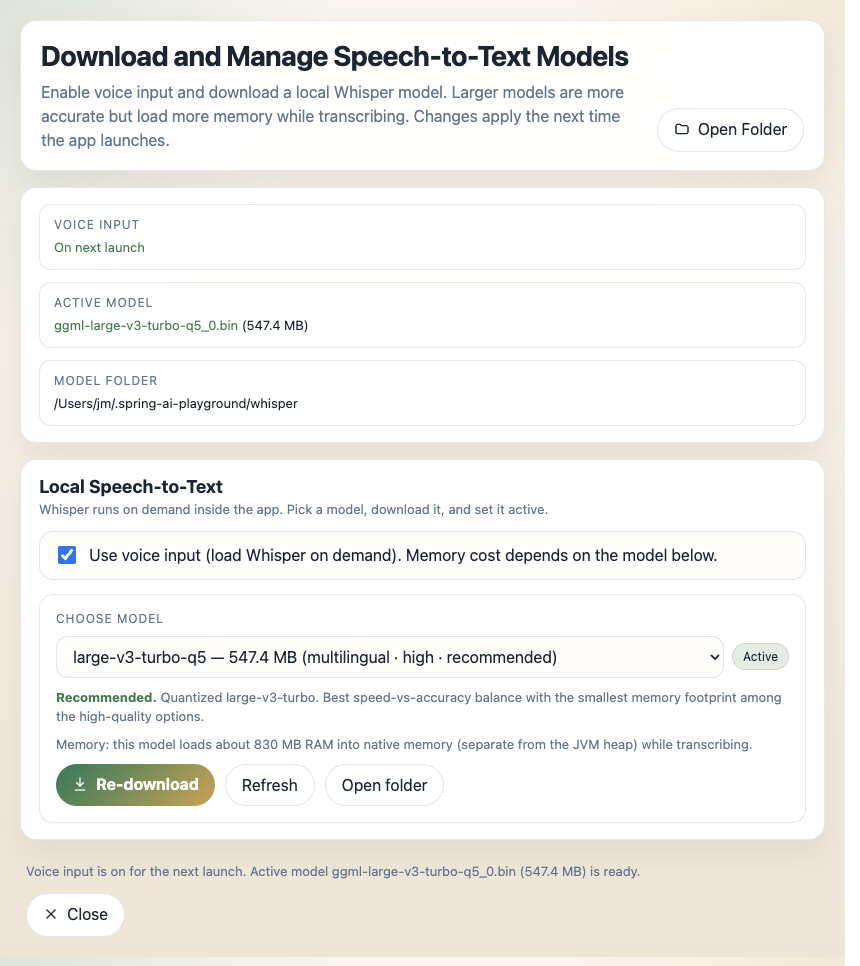
-
Pick a model in the manager. Larger models are more accurate but use more disk and memory:
Model Download Notes tiny~74 MB English only in practice, short utterances base/small~141 / ~465 MB multilingual, basic to fair medium-q5~514 MB multilingual, good large-v3-turbo-q5~547 MB recommended - multilingual, best speed/quality balance large-v3~2.9 GB most accurate, slowest - Click Download model. A progress bar shows the transfer with a Cancel option; files are saved under
~/.spring-ai-playground/whisper/. - Restart the app to apply - the card and the manager both show a restart hint whenever a change needs one.
The manager window also offers Set active (switch to an already-downloaded model), Refresh (re-check installed models), and Open folder (reveal the Whisper directory). A model uses extra memory only while it is transcribing, so the runtime memory cost scales with the model you choose.
Voice input is supported on Apple Silicon Macs. Intel Macs are not supported yet; there the chat mic shows a short notice, and in a browser it uses Web Speech instead. See Agentic Chat → Voice input for how the mic behaves in a conversation.
Further Reading
- Getting Started - universal post-install steps, model configuration, telemetry
- Configuration - every property / env var / default, and how to set it per launch mode
- Alternative Runtimes - Docker and source / fat-JAR alternatives
- Features → Tool Studio - author tools that the built-in MCP server exposes
- Tutorials - end-to-end workflows